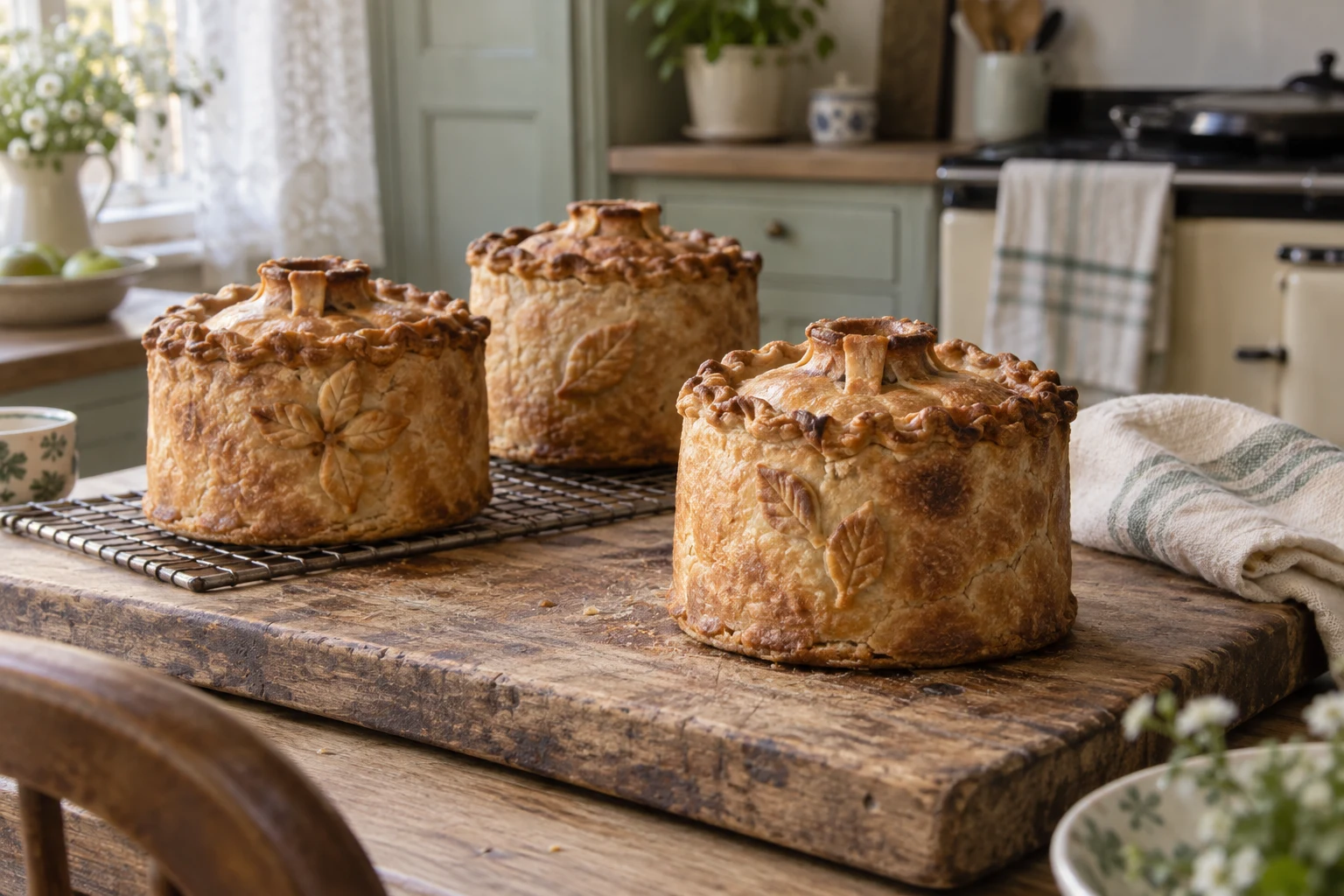
Gran’sPORK PIES

A FAMILY RECIPE, CARRIED FORWARD

ENGLISH ROOTS. A CANADIAN KITCHEN.

Gran’sPork Pies.

The recipe is on the page.
The knowing is in the hands.

Follow the making

Illustrative imagery · the handwritten pages are family originals.

A TRADITION LIVES IN THE MAKING

Another batch.
Another pair of hands.

It is kept alive each time someone warms the pastry, shapes a chimney and brings a pie to the table. The pages help us begin. Making it together carries the rest.

Meet the hands behind the pages ↓

THE SPACE BETWEEN THE LINES

Gran’s recipe is written
in a few lines.

The things between them live in the hands that make it.

Gran wrote for hands that already knew. Much of the making was ordinary kitchen work, too familiar to need explaining. Pat and Linda put more of it into words. Isaac is gathering the process for those interested.

Let’s make her pie ↓

BEFORE WE BEGIN · THE INGREDIENTS

Bring good things
to the table.

Ordinary groceries. A few considered choices.
Let’s start with what goes into the pie.

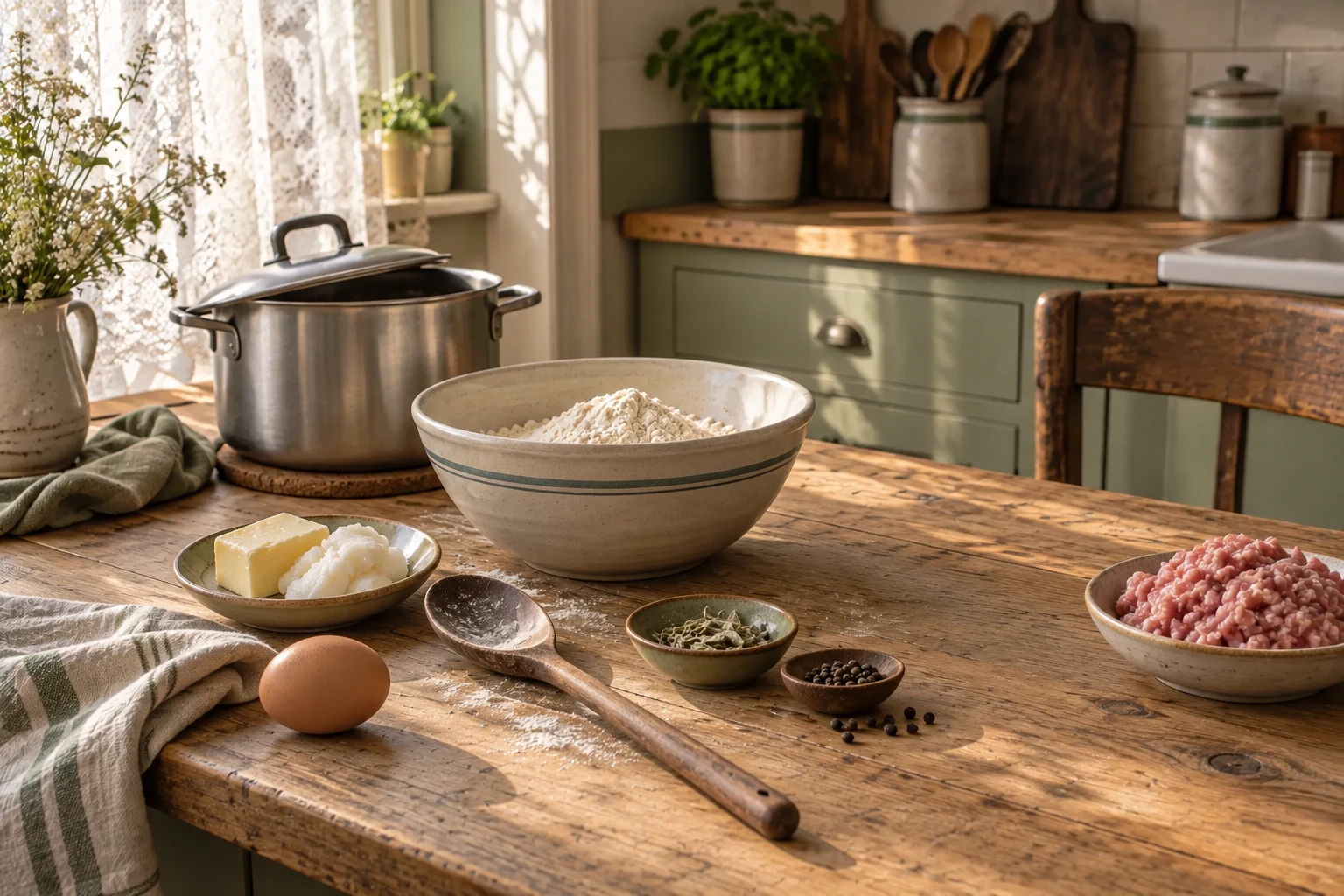
Illustrative morning kitchen with a stock pot, flour and pastry ingredients; a small bowl of pork sits to one side
A kitchen still life · illustrative ingredients, not measured recipe quantities.

Start with the pork.

Gran records 3 lb of ground pork. Explore the ingredients and the choices behind them.

Everything to hand. Now, the making. ↓

GRAN’S PORK PIES · THE MAKING

A little warmth.
A little patience.

Let the pie come together as you move down.
Pause at a family note whenever you like.

01 THE DAY BEFORE

Begin with what
comes last.

The jelly starts before the pie. Gran makes her “gravy” from a pork hock and a piece of rind the day before, so it is ready when the baked pies are cold.

1 pork hock + a piece of rind

+ The stock changes with the hands

Nan uses two pig feet; Linda and Pat use two hocks. Isaac records four cups of water for two hocks. Gran does not write a water quantity or simmering time. Keep her stock base distinct from those later instructions.

02 THE HOT-WATER PASTRY

First warmth.
Then a little work.

Sift the flour with the salt. Put the water, lard and butter together in a saucepan. Heat until the fats have melted and the water mixture reaches boiling point, then take it off the heat and stir it into the flour. When comfortable to handle, knead into a smooth dough.

7 cups flour · ½ lb lard · ⅛ lb butter
1 cup water · 1 tsp salt

+ The small matter of the butter

Gran records ⅛ lb. Linda writes ¼ lb, with ⅛ lb suggested by “Mom”. Isaac carries that question forward. This is a family variation, not a correction to Gran’s amount.

03 THE QUART SEALER

The jar lends
the pie its shape.

Weigh the kneaded dough and divide it into four equal portions. Following Pat, reserve about one-third of each portion for its lid; two-thirds forms the shell. Flour a clean quart sealer, turn it upside down, and centre a rolled round of warm pastry over its base. Ease the dough down evenly around the jar, rather than pulling it thin.

⅔ for the shell · ⅓ held back Pat’s approximate division

⅔For the shell⅓For the lid
g
For example: 1,200 g makes four 300 g portions—200 g for each shell, 100 g held back for each lid.

Pat writes: “Trim off approximately 1/3 of each quarter to use for lids.” The 2:1 split follows that sentence. Weigh your own dough; 1,200 g is an example. Allow pastry for the chimneys and keep the trimmings for decoration: no separate weight for these is recorded.

One-third for lids: Pat · page 1

+ From the jar to a standing shell

Linda and Isaac describe pastry hanging at least halfway down the jar; Isaac notes roughly ¼-inch thickness. Pat chills the formed shells until firm, then uses warm water inside the jars to release them. Turn the chilled jar-and-shell upright before adding the water, keep the water inside the jar, loosen gently and slide the jar out while supporting the pastry. This handling explanation connects the family’s short written steps; the jar is a mould, not part of the bake.

04 THE PORK & THE SAGE

This is where
it becomes hers.

Ground pork, sage, white pepper and salt. Our published recipe uses white pepper to keep the filling’s colour more consistent; black pepper is an alternative. Gran’s page gives the flavour in only a few words. Her sage makes a simpler seasoning than Nan’s warm-spice blend.

3 lb ground pork · 1½ tsp sage

05 FILLING THE CASE

Into the base.
Into the corners.

The released shell now takes the seasoned pork. Gran compresses the whole action into “Place in moulds”. Isaac’s notes give us the close-up: divide the filling, then work it into the base and corners of each case.

One quarter of the filling for each of four pies

Assembly detail from Isaac · page 3

+ Nan’s hand feels different here

Nan specifies a first layer about ½ inch deep, pressed firmly, then the remaining meat added lightly. Isaac describes packing the base and corners. Neither instruction establishes a numeric headspace below the lid.

06 FITTING & SEALING

Bring the edges
together.

Roll the four reserved pieces for lids while making the shells; Pat keeps them between layers of film so they do not dry out. She rolls the lids slightly thicker than the shells and fits each down inside its filled case, leaving an edge to turn up. Isaac adds the close-up: bring the lid against the meat without air pockets, then seal and crimp. Keep the end cuts for decoration.

Fit the lid → close the seam → crimp

Lid fit and crimping from Isaac · page 3

+ Keep the end cuts

Pat explicitly saves the trimmed pastry for decorations. Those little pieces will become part of the top of the pie after the chimney is fitted. Gran’s card is brief about the build; the family pages preserve these finishing details.

07 THE LITTLE CHIMNEY

A little chimney.
A way through.

Steam out in the oven; stock in afterwards. The open chimney lets steam escape as the pork cooks. After baking, that same opening gives the stock a way into the spaces around the meat, where it sets as jelly when chilled. Keep the passage clear when adding decorations and glaze.

Four 5 × 3-inch rectangles · Pat’s curled-down tops

+ Shape Pat’s chimney

Follow Pat: cut four pastry rectangles, each 5 × 3 inches—one chimney per pie. Cut an X in each lid and lift the flaps. Wrap foil around a pencil, then wrap a pastry rectangle around it to form a tube. Fit the tube into the opening and curl the lid flaps down to attach it. Slit the chimney’s upper edge and curl those little ends down. Remove the pencil and all foil before baking.

+ Isaac’s smaller chimney — a variation

Isaac and Linda draw a smaller 4 × 2-inch strip and use a film-wrapped pencil as a forming aid. That is a variation on the main method here, which follows Pat. In either approach, remove the pencil and all wrapping before baking and leave the passage open. Gran’s card records holes for the jelly but does not describe a constructed chimney.

+ The opening does the work

The curled pastry top is the family’s finishing touch. The opening through the lid is what matters for venting and filling: Paul Foster’s pork-pie method uses a simple hole to release steam, then the same hole to add jelly after chilling. River Cottage also pours its stock through the lid. Pat’s tube gives our pie its familiar chimney shape.

Paul Foster · steam and jelly ↗River Cottage · pouring the stock ↗

08 THE PASTRY END CUTS

Nothing wasted.
A little of your hand.

Keep the end cuts of pastry. Pat saves these trimmings for decoration; Linda and Isaac use egg white to attach the cut-outs. Arrange the little shapes on the lid around the chimney, leaving its opening clear. The pie begins to carry the mark of the person making it.

Pastry trimmings + a little egg white

Attaching the cut-outs: Isaac · page 3

+ The shape is yours to remember

The pages call for saved scraps and cut-out decorations, without prescribing one set of shapes. The leaves and small flower shown here are illustrative. A family photograph or bake can establish the exact decorations each keeper made.

09 BEFORE THE OVEN

A last brush
over the pastry.

With the chimney fitted and the pastry decorations in place, brush the pie with slightly beaten egg white. Gran gives the glaze its own short instruction: before baking. The lid, the crimp, the little shapes—each takes the same light coat.

Slightly beaten egg white

+ Why keep the glaze separate?

Published pork pies use different glazes, and some small moulded pies are removed and glazed again. Gran’s card gives one egg-white glaze before baking. It does not instruct a mid-bake removal or second glaze.

10 BAKING THE PIE

Into the oven.
Watch it turn gold.

The filled, sealed and glazed pies bake together. Preheat to 350°F, following Isaac. Pat uses a cookie sheet; Isaac lines it with parchment. Remove the jars and chimney-forming aids, leave space between the pies, and put the tray into the oven.

THE CENTRE TELLS YOU WHEN

71°C / 160°F

Measure the centre of the pork in every pie with a clean digital thermometer. Keep baking if it is below temperature. The golden crust and the clock are only part of the picture.

+ From the oven to the cold pie

Let the immediate steam subside, then refrigerate promptly with space for air to circulate, loosely covered while cooling. Gran’s jelly goes into a cold pie. Keep the overnight rest for the fridge, after the jelly is poured.

These whole pies still need a measured cooling record. Isaac’s 20–30 minute note is not a universal cooling time.

Read the cooling guidance ↗

11 WHEN THE PIE IS COLD

The final pour
finds its place.

Once the pie is cold, the chimney becomes the way in. Pour the prepared pork-stock liquid through it, following Isaac’s finishing notes. Gran’s card calls for holes in the tops of the cold pies and a filling of liquid gravy. The jelly finds the space between pork and pastry.

Cold pie + prepared pork-stock liquid

Pouring through the chimney: Isaac · page 3

+ Cooling is part of the method, too

The card does not give a cooling or storage method. Modern guidance calls for prompt refrigeration and monitored cooling; do not leave an intact meat pie out overnight. A practical cooling and jellying method for these particular pie sizes still needs a measured family bake. Isaac describes reheating set stock to pour; Gran calls it liquid.

Health Canada’s cooling guidance ↗

12 THE OVERNIGHT REST

Give the jelly
its night.

After the jelly is poured into the cooled pie, return it promptly to the fridge. Rest it overnight, level and protected, so the jelly can set around the pork. The next day, check that it has set before cutting the first slice.

POUR→FRIDGE · OVERNIGHT→SLICE

Overnight rest clarified by Isaac · 10 October 2026

+ The quiet work of the fridge

Keep the fridge at 4°C or below. This setting stage follows safe cooking and cooling; it does not replace the initial cooling procedure. River Cottage also rests its jellied pork pies in the fridge overnight. Gran’s card leaves that final pause unwritten.

13 THE PIE, COMPLETE

A small pie.
A generous slice.

Cold pork, set jelly and a firm pastry shell make a compact, substantial pie. Give the jelly its overnight rest in the fridge before cutting. A modest wedge brings a little of every layer to the plate.

Begin with six to eight wedges per pie, according to appetite and what comes alongside. This is a serving suggestion; the weight of your finished pie is the better guide.

THE JAR GIVES THE SHAPE

Gran’s 3 lb of pork, shared between four pies, is about 340 g of raw pork in each—before pastry, jelly and the changes during baking.

A quart is the jar’s inside capacity. The pastry fits around its outside and only partway down, so it does not tell us the pie’s volume or finished weight.

Illustration of the form, not a measured family pie.
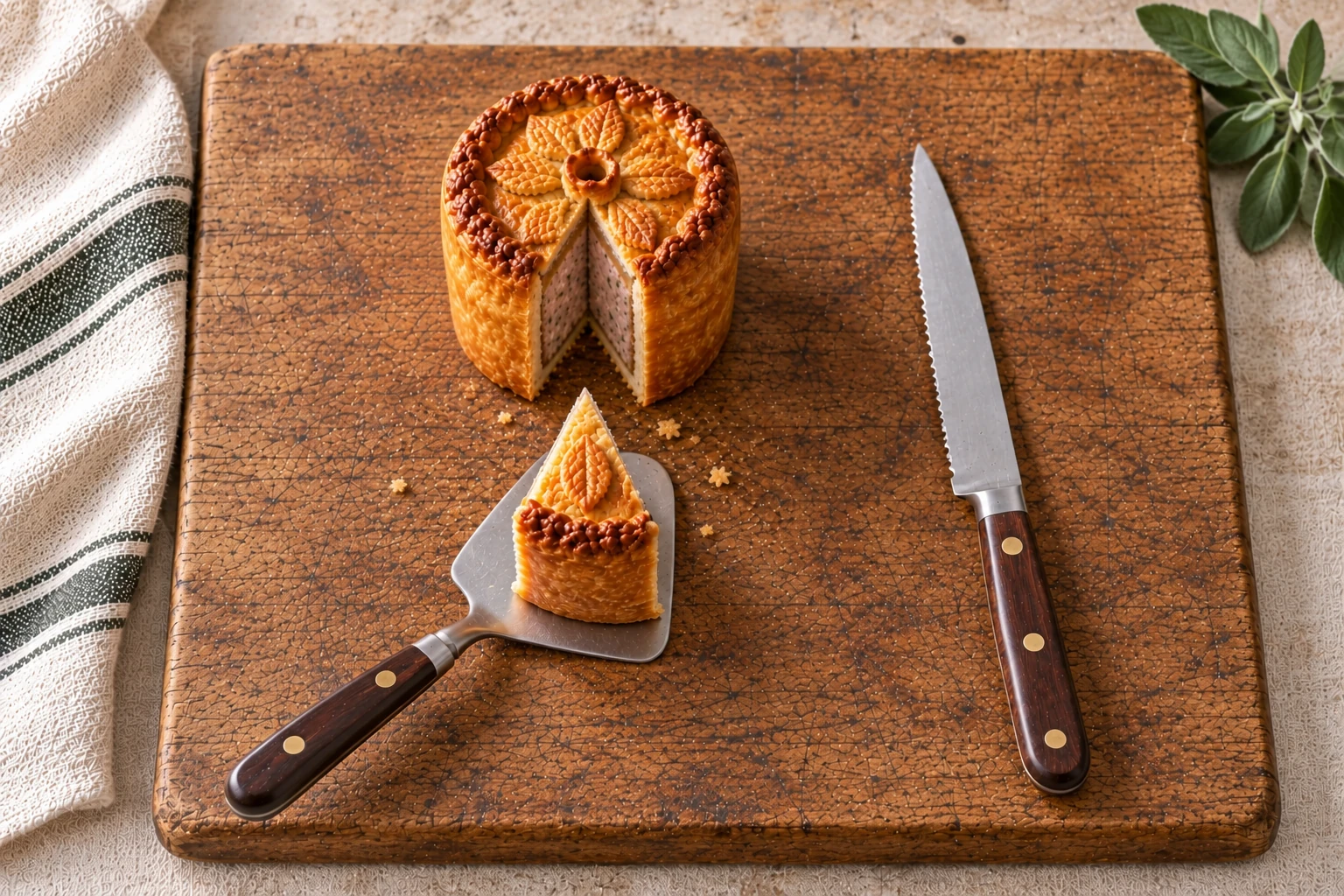
FROM THE BOARD · CUTTING & LIFTING

Let the knife
do the work.

A chilled pie with fully set jelly is easier to support. Set it on a steady board. Plan a narrow wedge; avoid cutting straight through a raised decoration if you can.

  1. Saw the crust gently. A sharp, pointed knife with fine or medium serrations is a forgiving starting choice. Small strokes open the lid and crimp without pressing the pie flat.
  2. Finish both cuts. Make two cuts meeting at the centre, through the filling and all the way through the base. Steady the side lightly, with fingers clear of the blade; do not bear down on the decorated lid.
  3. Support, then lift. Slide a broad server right underneath. If the wedge catches, finish the cut rather than twisting or levering it free.
Which knife feels easiest? +

A lightweight pointed serrated utility knife gives good control on a small pie. A sharp bread knife also works, though a long, blunt-ended blade can feel awkward near the centre. Coarse, aggressive teeth may tear the crimp.

A sharp, thin carving knife gives a clean filling cut once the crust is opened. Wipe the blade between portions. Avoid a heavy, blunt knife that needs force to break through.

This applies published pastry-cutting advice to a cold pork pie; it is a technique to try, not a rule from Gran’s page.

King Arthur’s knife guidance ↗
Overhead illustration of a radial wedge removed from a round pork pie and supported underneath by a pie server; a serrated knife rests beside the board.
Two cuts meet at the centre. The whole base is supported. · Illustration

A wedge of the whole round.
The two cut faces meet at a point. Pastry stays on the top, base and curved outer edge.

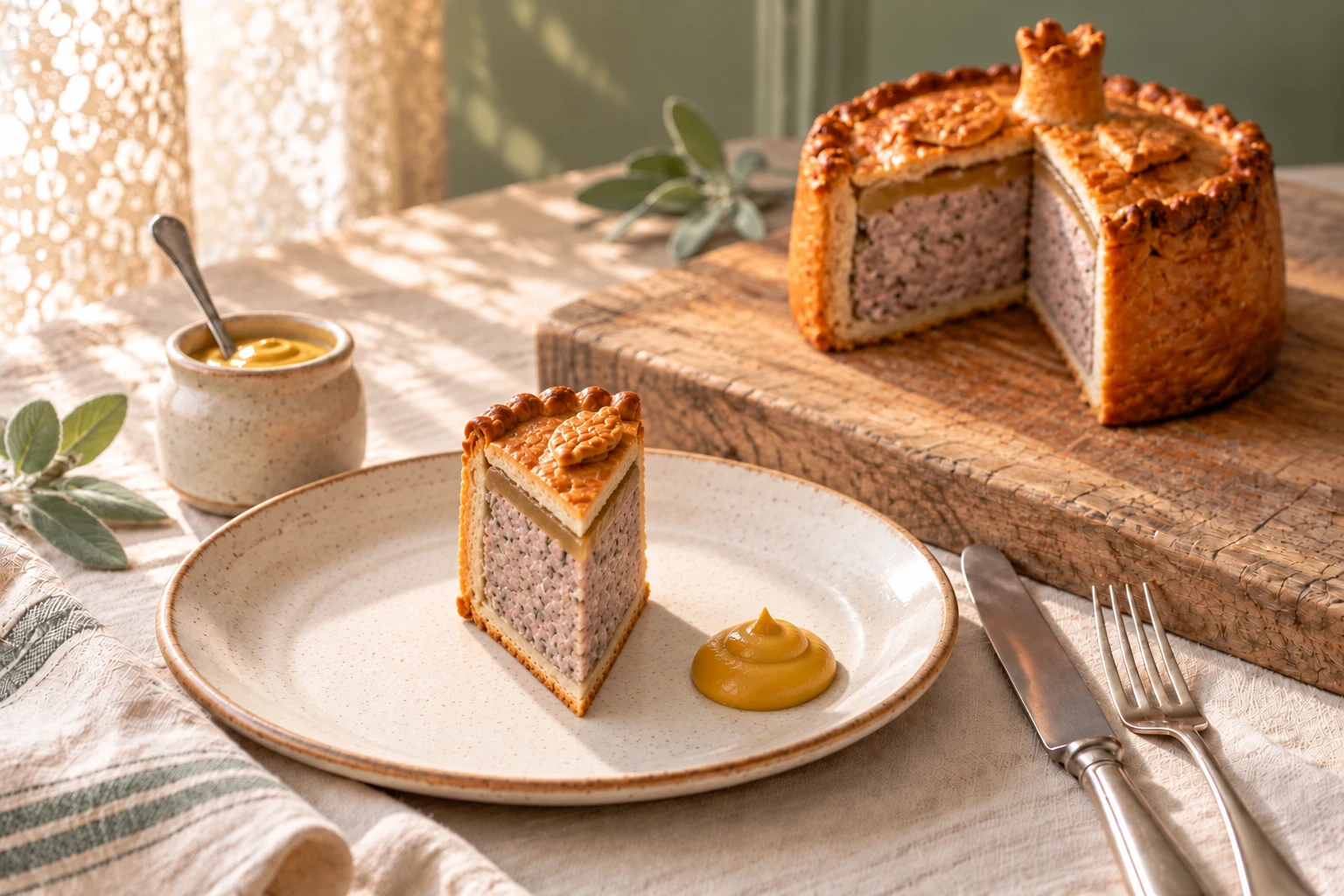
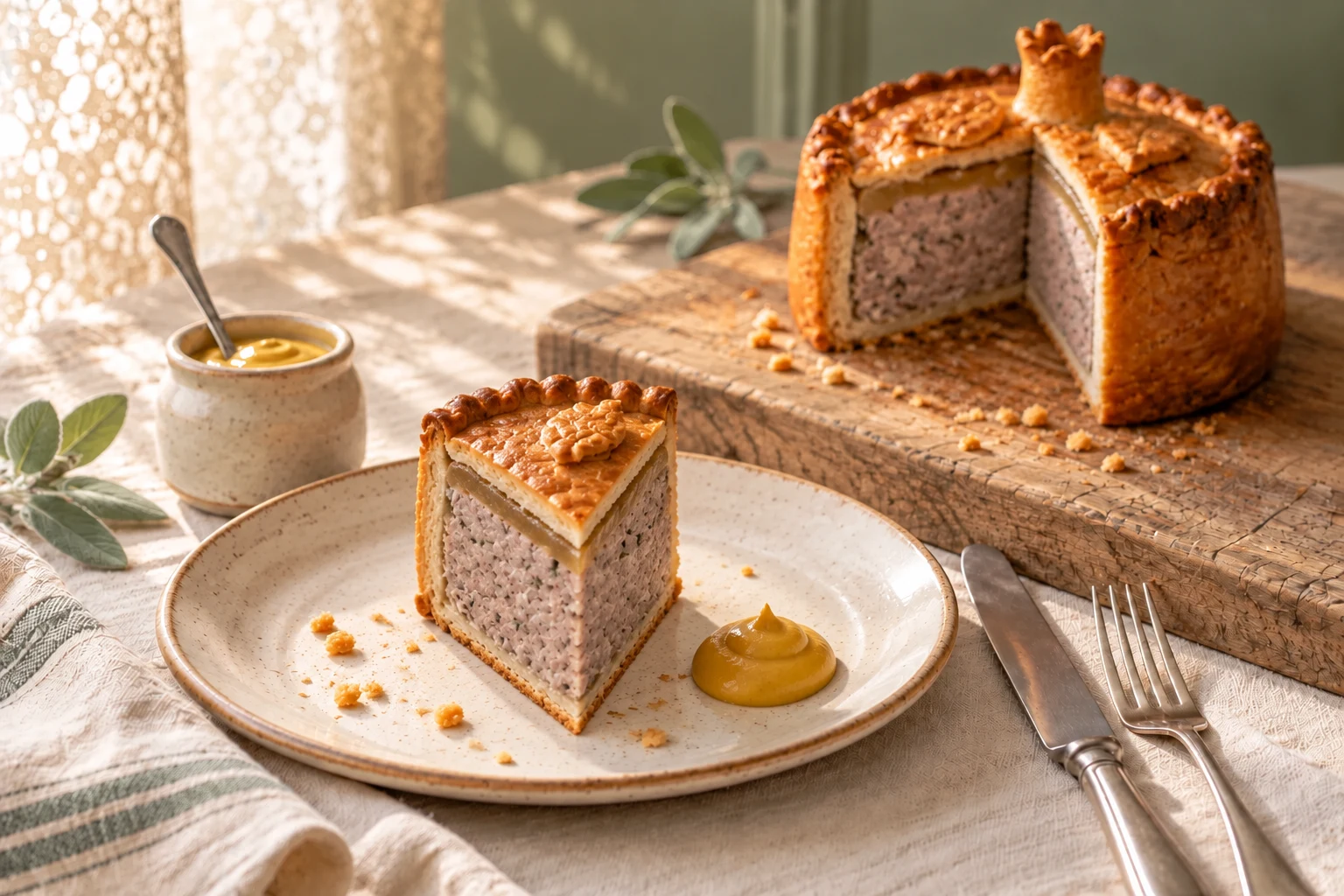
Illustration of a slice of pork pie with set jelly and English mustard on an ivory plate; the decorated pie rests on a wooden board behind it.
A slice from the whole pie. Illustrative image.

THE MAKING BECOMES A MEAL

Now,
a little mustard.

In our family, mostly English mustard.

After the pastry, the pork, the jelly and the waiting: a slice on a plate. A little mustard beside it. Something made to be eaten together.

Stay at the table ↓

ON THE PLATE · SERVICE & PLACEMENT

Set it down.
Leave a little room.

Set the chilled wedge upright on a plate, with its cut face visible. Leave a little room beside it for mustard or pickle. Put condiments alongside so each person can choose their own amount.

A knife and fork let you take a little crust, pork and jelly in the same mouthful. If you are serving several people, offer cut portions from the board and replenish as needed; keep the remaining pie chilled.

Keeping the pie ready to serve +

Bring out the portions you are serving and keep the rest refrigerated at 4°C or below. At a picnic, use an insulated cooler with ice packs. Refrigerate leftovers promptly.

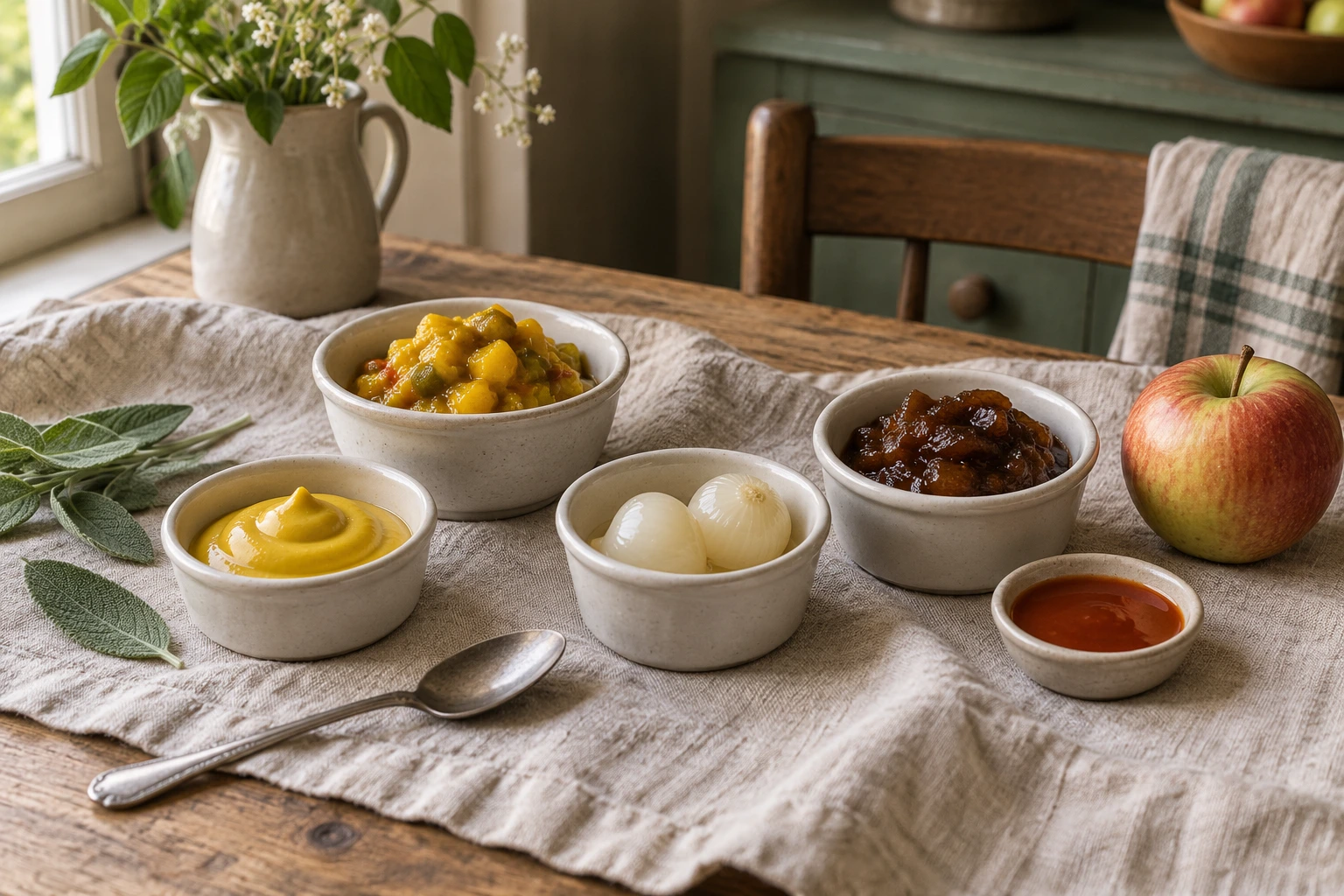
Small bowls of mustard, piccalilli, pickled onions, chutney and hot sauce on linen.
A little contrast, chosen to taste. · Illustration

A LITTLE ALONGSIDE

Sharp, sweet,
or simply the pie.

A few salad leaves, bread or cheese can turn a slice into lunch. Keep the plate simple enough to taste the pie.

SOMETHING TO DRINK

A pot of tea.
A glass of something.

Choose a drink that leaves room for the pork and sage. Open a group, then explore the choices within it.

Suggestions to taste and compare. The family’s usual drinks have yet to be recorded.

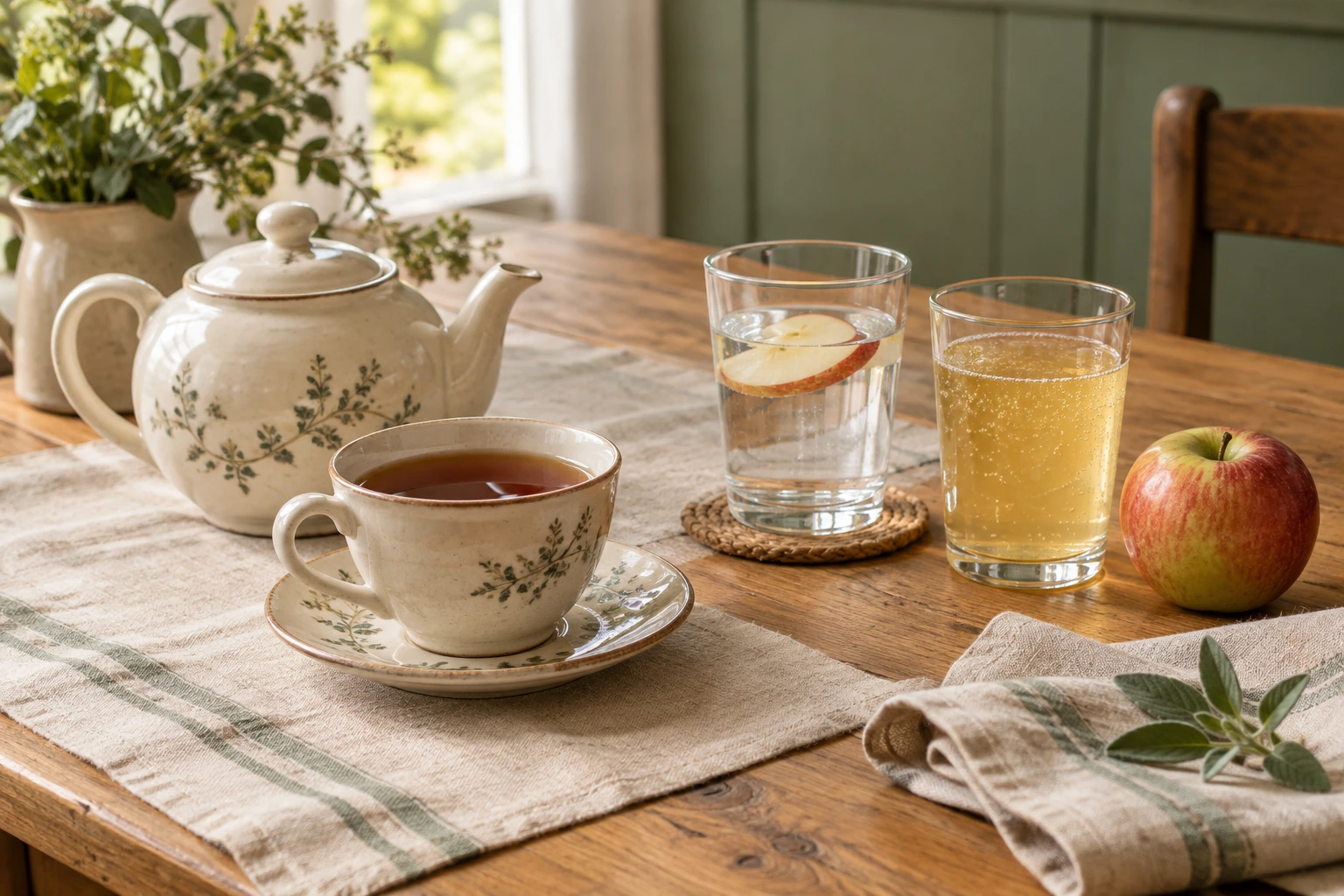
A pot and cup of tea beside apple water, sparkling apple juice and a fresh apple.
The gentler choices have a place at the table too. · Illustration

AT OTHER TABLES · ENGLAND & CANADA

Familiar food.
Different company.

A pie can be a cold lunch, a remembered Christmas breakfast, or something a butcher carries into a new community. These accounts belong to the people and places named.

A SHARED TRADITION

Kept alive
by many hands.

Some write the recipe down. Some remember how the dough should feel. Others make the stock, shape the pastry, bring the mustard or gather everyone at the table. We all play a part in keeping Gran’s pie alive.

Five voices on the page.
Many more around the table.

A saved page is one contribution. A remembered gesture, a new batch or a shared meal is another.

Gran’s recipe · prepared display copy

Explore a name to see the pages. Select it to read.

Gran’s few lines carry a great deal of knowing. The everyday actions did not all need writing down; the family already understood them.

AN OPEN PLACE IN THE FAMILY

And how do you make yours?

For family members keeping this pie alive: your ingredients, your way of making it, the small things you remember. There is room for another version.

THE HISTORY · INGREDIENTS, HANDS & PLACES

Where did
this pie begin?

A warm pastry shell, seasoned pork, a little stock that sets. Each part has a history. Follow the methods through English kitchens and Canadian cookbooks, then look closely at what changed along the way.

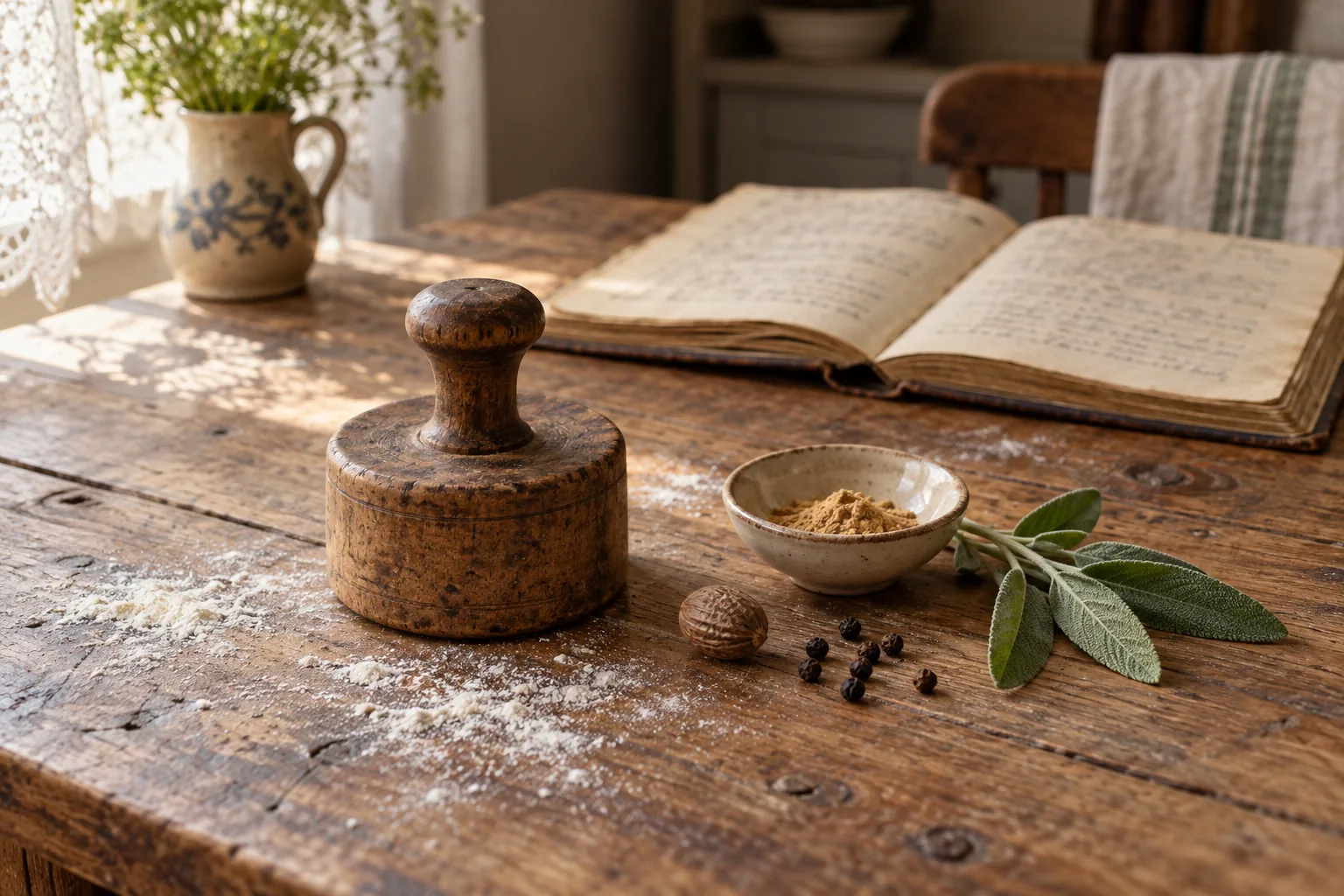
Illustrative still life of spices, an old recipe book and a wooden pie dolly in morning light.
The things a recipe carries: a method, a flavour, a way of working. · Illustration

WHAT THE RECORDS SUGGEST

A shared craft.
A particular family recipe.

Gran’s pie belongs to the English tradition of raised pork pies, continued in a Canadian kitchen. The jar, the hot pastry, the seasoning and the jelly appear in different combinations in older recipes. Together they explain the kind of pie she makes. They do not yet identify who taught Nan, when the recipe crossed the Atlantic, or one county where it began.

PLACES & PRINTED RECIPES

Follow a thread through time.

Choose a chapter. The map follows the record: a recipe region, a publishing town or a place where the ingredients changed.

01c.1390 · 1672 · 1747

Long before
the mincing machine.

Around 1390, the Forme of Cury records chopped pork with eggs, cheese, spices and pine nuts baked in pastry. It is an older English pork-in-pastry tradition, with a very different filling from ours.

In the 1672 edition of Hannah Woolley’s The Queen-like Closet, a leg-of-pork pie carries herbs, pepper, cloves and sage. It is baked with butter and eaten cold with mustard and sugar. There is a familiar echo at the table, centuries before our family pages.

Hannah Glasse’s 1747 Cheshire pork pie brings another branch: pork steaks with apples, sugar, nutmeg and white wine. These records show a family of changing dishes. They do not yet establish Nan’s particular mince, hot-water shell and poured stock jelly.

The London pin locates Woolley’s publisher. It is not a claim about where the medieval recipe originated.

021814 · 1845 · 1861

Older than
the pages we keep.

In an 1814 edition, Maria Rundell describes cold pork pies with a boiled raised crust and closely packed pork. Jelly is not stated there. By 1845, Jane Loudon describes the Warwickshire pies she knew: lard pastry, pork, and bone gravy added after baking.

Loudon also points to neighbouring counties. In 1861, Beeton’s Warwickshire method forms pastry around a bottle or jar—a close practical cousin to Gran’s quart sealers. This is a shared craft, already travelling between kitchens.

03MELTON MOWBRAY · 1864

A pie belongs
to a food landscape.

Around Melton, dairying, pig keeping and pie making supported one another. Whey from cheese making could feed pigs. The connection helps explain an industry; it does not identify the pork Nan bought.

Visiting the town, Elihu Burritt described a pie factory with moulds, ovens, cooling racks and a packing room. His 1864 account connects the pies with railway refreshment rooms. The railway carried a local speciality outward; it did not invent the pie.

04OTTAWA · 1881

The practice was
already in Canada.

Before we can date the family’s own crossing, we can see the craft in Canadian print. The 1881 Ottawa cookbook The Canadian Economist includes raised little pork pies: hot lard-and-water pastry, finely cut pork, a crimped lid, and pork-bone gravy added after baking.

That establishes circulation in Canada, not a route to Gran. Gran is Canadian; the family tradition comes from England. The people, places and dates joining those two facts remain a family investigation.

05LONDON TRADE MANUAL · 1900

Nan’s spices open
another cupboard.

Salt, pepper, ginger, mace, nutmeg. Nan’s bulk seasoning blends lead us to Frederick T. Vine’s Savoury Pastry. His 1900 trade manual brings those spices together with sage, then describes cutting or mincing pork, raising cases on wooden blocks, and adding jellied stock after baking.

It is the closest combined seasoning-and-method comparison found in this research. The proportions differ; it is not an exact recipe match. A London-published trade book speaks to a circulating practice, rather than one county’s signature.

06A JAR · A MINCER · A FAMILIAR OVEN

The kitchen changes.
The knowing carries on.

Gran’s quart sealer is a preserving jar doing a second job. A surviving Canadian Gem jar, made in Wallaceburg between 1895 and 1913, places that ordinary object in a material history. It does not tell us Gran's jar brand - but helps understand when the tradition started.

Mincers made preparation repeatable. Regulated ovens helped turn familiar heat into numbers. Refrigerators changed what “a cold place” could mean. These tools help explain how instructions evolve while an older practice continues.

07LACOMBE · 1913 → 1958

On the Prairies,
the pork has a story too.

In 1913, four Yorkshire sows arrived at Lacombe’s experimental station from Ottawa; a Berkshire sow joined the herd. A 1927 report describes feeding home-grown oats and barley, and skim milk where dairying supplied it. Here, too, pork belonged to the surrounding farms.

In 1947, researchers selected Berkshire, Danish Landrace and Chester White foundations for a Canadian breed. The Lacombe was registered in 1957 and released in 1958. These are documented agricultural connections, not a pedigree for the pork in Gran’s pie.

LOOK CLOSER · EIGHT INGREDIENT & METHOD STUDIES

The history
inside the pie.

Recipes keep familiar names while their ingredients and tools change. Open a study to compare dated recipes, regional habits and the choices preserved in our family’s pages.

Each study ends back in Gran’s kitchen.

01

Hot-water pastry

A shell strong enough to stand, with more than one way to make it.

Hot liquid helps make a firm, mouldable dough. The substantial shell carries its filling; it is a different job from making layers of flaky pastry.

  1. 1672 · An English household book

    Woolley gives a raised paste made with hot liquid, butter and suet. Elsewhere she strengthens a cold-meat crust with dissolved isinglass. These are distinct pastry instructions in the same book; her pork-pie recipe does not tell us which one she used. The old kitchen already had several ways to build a substantial case.

  2. 1814–1861 · Raised crust in print

    Rundell’s cold pork pies use a boiled raised crust. Loudon’s 1845 account makes hot lard-and-water pastry, while Beeton’s Warwickshire recipe rubs part of the lard into flour, then adds the remainder melted in boiling milk. The hot liquid, fat and order of mixing vary even where the finished pies share a raised shape.

  3. 1881 · Ottawa / 1900 · the pastry trade

    The Canadian Economist’s little breakfast pies use hot lard and water. Vine’s later trade manual gives a pork-pie paste with both lard and butter heated with liquid. These are useful comparisons for Gran’s method: boil the water, lard and butter together, stir into the flour, then work the dough when it is comfortable to handle.

  4. The technique · Why warmth matters

    Modern baking explanations describe hot liquid hydrating the flour’s starch to make a sturdy crust. Loudon’s older practical test is more immediate: pastry must be warm enough to mould, yet firm enough to stand. Warm shaping and later chilling of an already formed shell are different stages, so Gran’s cold firming is not a contradiction of the earlier warm-dough advice.

02

Hands, blocks & jars

A raised case, a wrapped wall, a wooden dolly, a quart sealer.

Different tools solve the same problem: keeping a hollow shell upright.

  1. 1845 · Warwickshire & Northamptonshire

    Loudon describes raising the Warwickshire case with the hands. Her Northamptonshire comparison is assembled from separate pieces: a base, a strip for the wall and a lid, with a removable tin sometimes supporting the outside. These are neighbouring approaches, not steps in a single march from primitive to improved.

  2. 1861 · A bottle or a small jar

    Beeton’s Warwickshire method draws the warm paste around an ordinary bottle or jar. Once the case holds its shape, the former comes out. This is the closest early tool comparison to Gran’s quart sealers: an everyday vessel lending its shape to pastry.

  3. 1864–1900 · The maker’s workshop

    Burritt’s Melton factory visit records moulds among the equipment of a growing pie trade. Vine later explains wooden blocks for raising cases. Reusable formers help a maker produce repeated shapes; their appearance in commercial work does not mean household hand raising disappeared.

  4. 1895–1913 · A Canadian object

    A Gem preserving jar made in Wallaceburg survives in the McCord Stewart collection. It places the sealer in a Canadian household history. It does not identify Gran’s brand, and the size of a jar’s interior does not measure the volume of a pie raised around its exterior.

03

The flour in the sack

Wheat varieties, milling and flour grades tell different stories.

Before flour reaches the pastry board, a farmer has chosen a wheat and a miller has decided how to grind and separate it. Those choices were already being discussed centuries before the family pages.

  1. 1744 · English wheats had names, and markets

    William Ellis describes Red Lammas arriving from Northamptonshire, Bedfordshire and Buckinghamshire at the markets around St Albans and Hemel Hempstead, where watermills supplied the London trade. He praises its fine white flour and explains that its tougher skin separates into larger flakes of bran. He also describes white wheat being grown and ground with red or yellow Lammas: the different grains could complement one another at the mill. His bearded Duck-bill or Dugdale wheat had different local names, including Grey-poll Rivet in Essex and Grey-poll or Blue-poll in the West Country. The flour supply was already varied, regional and blended. These names describe crops and their milling behaviour; they are not ingredients specified by an early pork-pie recipe.

  2. 1805 onward · Inside a windmill or watermill

    Lytham's windmill, leased for construction in 1805, offers a surviving example of the machinery behind the flour sack. Gears transmitted the sails' power to the upper runner stone, which revolved just clear of the stationary bedstone. Grain entered through the eye at the centre. Crossing furrows cut it as it travelled towards the rim. Watermills used the same grinding principle with a different source of power. Keeping the surfaces true and recutting their grooves was the skilled work of stone dressing; the working mill at Acorn Bank still demonstrates it. Grinding was only part of the job. A bolter or flour dresser then sifted meal through cloth or wire, separating fine flour from bran. White flour could therefore come from stones: stoneground and wholemeal are not synonyms.

  3. 1844–1904 · A changing English wheat field

    Rothamsted's Broadbalk records let us follow actual crops in one Hertfordshire field. Its first experimental crop was sown in autumn 1843; the 1844–48 harvests were Old Red Lammas. Old Red Cluster followed in 1849–52, Red Rostock in 1853–81, Red Club in 1882–99, and Squarehead's Master in 1900–04. This is a precise record of a changing experiment, rather than a catalogue of every British farm. Alongside the Canadian varieties already discussed, it shows why the same short recipe instruction could be carried forward while the wheats available to millers changed.

  4. Late nineteenth century · From stones to rollers

    The later roller systems made separating white flour from bran more efficient. They did not invent white flour: bolting had already separated the meal from stone mills. The distinction is between how grain is broken down and how its parts are separated. A white flour could be stoneground; a roller mill could also make wholemeal.

  5. 1842–1907 · Red Fife & Marquis

    Red Fife, selected in Ontario in 1842, helped establish Canadian spring-wheat production. Marquis combined Red Fife with Hard Red Calcutta from India; it was selected in 1903 and sent for Western Canadian trials in 1907. The federal 1956 handbook describes its strong, elastic dough and value in blends with weaker wheats. These are changes in the flour supply, not evidence of Gran’s purchase.

  6. 1900 · The pastrycook chooses from the sack

    Frederick Vine's trade manual compares Vienna flour, English patent flour and imported American flour, and allows blending when the available flour needs adjustment. His discussion is practical: colour, fineness, dough strength, handling and cost all matter. He makes an explicit distinction at the end. The preceding preference for Vienna flour concerns puff pastry; for short or boiled crusts he chooses a good-colour country patent flour instead. He also recognises that a dough which pulls back may need time to rest. The useful link to Gran's pastry is this attention to workable dough, not the idea that one old wheat name unlocks an authentic pie.

  7. 1956 · Another Alberta flour story

    The same handbook records Lemhi, a soft white wheat grown on irrigated land in southern Alberta, as suitable for cake and pastry flour. Canadian flour was never just one wheat or one strength. Variety, milling, blending and intended use all belong in the history; the family page identifies none of those particulars.

04

The pork itself

Cut, breed, fat and grind each change the character of a slice.

There has never been just one part of the pig in every pork pie.

  1. 1672–1861 · Leg, loin & neck

    Woolley begins with a leg of pork boiled before baking. Kitchiner’s 1830 edition uses loin chops beaten with a chopper. Beeton’s small raised pies use neck meat cut small; her separate Warwickshire recipe names no cut, but packs nut-sized pieces in alternating layers of fat and lean. These are different fillings as well as different textures.

  2. 19th century · English markets & changing breeds

    The British Pig Association dates Middle White recognition to 1852 and links its later “London Porker” name with the fresh-pork market. Berkshire breeding changed substantially, including Asian contributions. Breed names describe developing animal populations. They cannot tell us the cut, trimming or fat content of an individual pie.

  3. 1913–1958 · Central Alberta

    Lacombe’s herd began with Yorkshire sows from Ottawa and a Berkshire sow. Its 1927 report discusses home-grown oats and barley, and skim milk where available. A later breeding programme brought Berkshire, Danish Landrace and Chester White foundations together; the Lacombe breed was registered in 1957 and released in 1958. This is documented Prairie supply history, not the pedigree of Gran’s pork.

  4. Today · A regional specification, a butcher’s choice

    The protected Melton Mowbray specification permits diced or minced uncured pork and prescribes no breed. Uncured describes treatment, not an absence of salt seasoning. In Canada, “lean” ground meat has a maximum 17% fat and “medium” 23%; neither label is an exact percentage. Historic fat-and-lean layering and modern retail fat grades answer different questions.

05

Lard, butter & suet

Different fats, different mixtures—and a changing household supply.

The history is richer than a rule that pork-pie pastry must contain only lard.

  1. 1672 · Butter appears in more than one role

    Woolley’s raised-paste instructions combine butter with suet. Her leg-of-pork pie also has butter placed with the meat. Fat in a crust and fat added to the filling are separate choices; a mention of butter does not by itself identify the pastry formula.

  2. 1845–1872 · Neighbouring formulas

    Loudon’s raised pastry uses lard, with butter allowed as a substitute. Beeton’s Warwickshire recipe uses lard and milk. Warne’s 1872 small Yorkshire pies use a butter-and-suet crust. These published variations make it difficult to draw a county boundary from the pastry fat alone.

  3. 1881 / 1900 · Lard alone, then a mixed-fat comparison

    Ottawa’s little breakfast pies use lard in their hot-water crust. Vine’s pork-pie paste includes both lard and butter. The records preserve alternatives rather than a universal change from one fat to another. Gran’s own mixture belongs comfortably within that wider range of practice.

06

The salt

An ordinary ingredient whose origin and crystal size often go unrecorded.

From coastal salt pans to the old pie shops: what the records tell us about an everyday ingredient.

  1. English supply · Coast & inland brine

    English salt could come from seawater or inland brine. A Science Museum model records Cheshire open-pan salt making: brine was evaporated into white salt, with working conditions producing different crystal sizes. That is the supply landscape around a kitchen, not proof of which salt a particular cook used.

  2. 1814–1881 · The recipe usually just says salt

    Rundell, Beeton’s raised pies and the Ottawa breakfast pies do not name a mine, coast or brand. Beeton does distinguish common salt, bay-salt and saltpetre elsewhere, in pork-preserving recipes. Those separate curing lists must not be imported into the filling of an uncured pork pie.

  3. Makers since 1824 & 1851 · What their labels tell us today

    The old shop names give us a useful comparison, although their present-day ingredient lists do not reveal everything. Walker & Son has been making pork pies since 1824, according to M&S, which names the maker of its current Melton Mowbray pie. That pie lists simply “Salt”. Dickinson & Morris traces its Nottingham Street shop to 1851; the public ingredient list for its standard individual Melton Mowbray pie also says “Salt”. Neither description identifies the salt's origin or whether iodine has been added.

  4. 2025 · Sea salt, explicitly named

    Sea salt does appear explicitly in a newer recipe connected with that older trade. Calum Franklin's black-treacle-and-orange pork pie, published in 2025 and created with Dickinson & Morris, calls for sea salt in the hot-water pastry, filling and jelly. It is a festive variation, with its own flavours, rather than evidence of the salt used at the shop in 1851.

07

Pepper, white & black

A familiar word can conceal a different aroma—and cayenne is another spice.

Pepper is an old companion to pork, but its colour is not always stated.

  1. 1672–1814 · Pepper already belongs here

    Woolley seasons her leg-of-pork pie with pepper among herbs and cloves. Rundell’s cold raised pies call for salt and pepper. The familiar pairing is explicit; the colour of that pepper is not.

  2. 1861 · Two choices in one book

    Beeton’s Warwickshire pies include pepper and a little cayenne. Her little raised pies explicitly use white pepper with sage. This is firmer evidence than retrospectively calling every unnamed pepper black. Cayenne adds a separate spice, rather than another colour of the same peppercorn.

  3. The plant behind the names

    Black and white pepper come from Piper nigrum, processed differently. Kew describes black pepper as the dried fruit and white pepper as the seed with the outer layer removed. A change from one to the other can be a flavour choice within an otherwise familiar recipe.

08

Sage & the spice tin

Garden herbs, imported spices, and the simpler and richer recipes made beside one another.

Sage belongs to a long English pairing of herbs with pork. Imported spices appear in elite recipes by c.1390; by the later 1600s and 1700s, pepper and warm spices recur in printed English cookery. Everyday use still depended on means, place and taste.

  1. c.1390 · Sage and spice are already neighbours.

    Sage grew in medieval herb gardens and served both cooking and medicine. The Forme of Cury puts parsley and sage into a sauce for boiled pig; elsewhere, seasoned pork is wrapped in sage leaves and fried. Its pork pastries use saffron and spice mixtures. These are different dishes, but they establish a broad vocabulary centuries before Gran. English Heritage places imported spices such as ginger among the expensive ingredients of wealthy medieval tables. A royal recipe collection cannot tell us what every household ate.

  2. 1600–1685 · A garden’s worth of herbs.

    The East India Company received its charter in 1600 and began trading pepper and spices; those imports were not new to England. Woolley’s 1672 pork pie combines herbs, sage, pepper and cloves. May’s 1685 gammon pie names sage, thyme, parsley, sweet marjoram, savory, fennel and rosemary among a much longer herb list, alongside nutmeg, pepper and cloves. These elaborate recipes show herbs and imported spices working together, rather than replacing one another.

  3. 1747–1814 · Richly seasoned and simply seasoned.

    Glasse’s 1747 Cheshire pork pie uses salt, pepper and nutmeg with apples, sugar and white wine. Rundell’s cold pork pies, in the checked 1814 edition, season the meat with pepper and salt. Warm spices were familiar in the printed repertoire, but their availability did not make them compulsory. These books preserve different choices rather than a single progression from plain pork to elaborate seasoning.

  4. 1861–1872 · A recognisable sage branch.

    Beeton’s 1861 little raised pork pies use salt, white pepper and powdered sage. Her Warwickshire recipe instead names salt, pepper and a little cayenne. Warne’s 1872 small raised Yorkshire pies also use sage, pepper and salt. This gives Gran’s seasoning a close printed companion, while showing that neighbouring English traditions could taste different. Similar recipes also circulated between books: their county labels do not establish the family’s birthplace.

  5. 1881 · English names on a Canadian bookshelf

    The Canadian Economist prints a Cheshire pie and a Yorkshire variation: leave out the apples, sugar and nutmeg, and use sage. It credits Common Sense in the Household. Elsewhere the same book’s little breakfast pies use salt and pepper with bone gravy. Several regional and seasoning choices were circulating together in Canadian print.

  6. 1900 · The plain and the enhanced, side by side.

    Vine gives pork-pie makers a direct choice: pepper, salt and sage, or his A1 seasoning, which adds ginger, mace and nutmeg to that foundation. He tells them to suit their neighbourhood’s taste. His aromatic mixture also uses marjoram, basil, thyme and bay for wider savoury work. By this point, the simpler herbal profile and the richer blend are explicitly alternatives within the same trade manual.

Dates identify the editions or records examined, not the invention of a dish. Regional names describe the cited recipe or convention; they are not a map of this family’s ancestry.

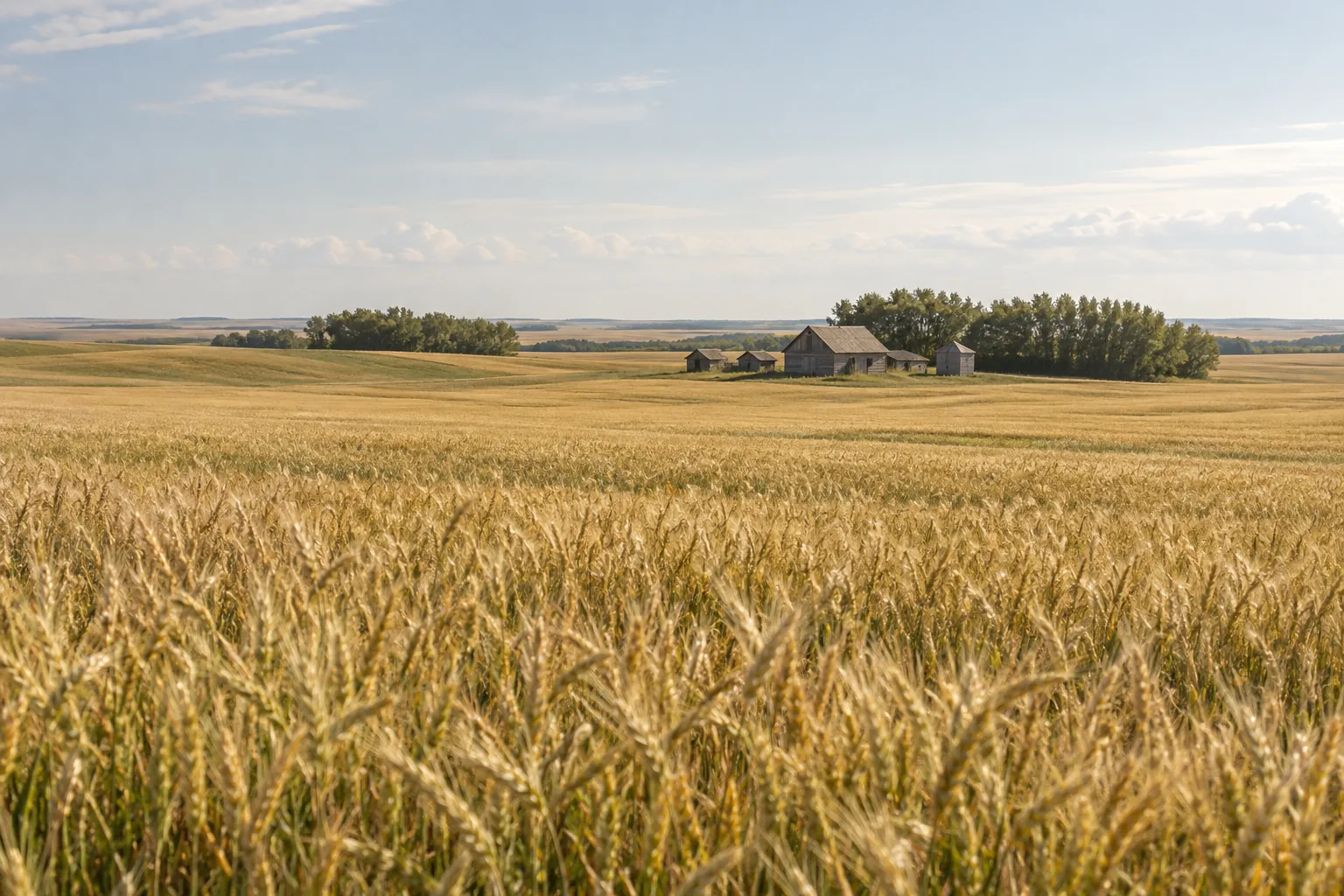
Illustrative Prairie grain fields and distant farm buildings in late morning light.

A different landscape.
The same work of keeping a recipe.

THE HISTORY RETURNS TO THE KITCHEN

The jar. The seasoning.
The hands that kept them.

A SHARED WAY OF MAKING

Gran’s quart sealer has older cousins.

Beeton’s 1861 Warwickshire pie is raised around a bottle or jar. Loudon, writing in 1845, describes adding bone gravy after baking. Together they place familiar actions from our kitchen within a much older English craft.

THE OLDEST FAMILY CLUE

Nan’s spices widen the search.

Ginger, mace and nutmeg lead beyond Gran’s sage. Vine’s 1900 trade manual brings a similar group of spices together with raised cases and stock jelly. It is a close comparison, with different proportions, in a practice travelling through print.

A CANADIAN CONTINUATION

The tradition found another kitchen.

Raised pork pies with gravy appear in an Ottawa cookbook in 1881. Gran is Canadian; her family’s tradition came from England. Our pages show how it continued here, even while the people and dates of that crossing remain to be found.

The strongest conclusion is a connection to English raised-pie making, preserved and adapted in a Canadian family. No single county is established. The next useful clue may be a remembered place, an older page or the name of someone who taught Nan.

Illustration of a fresh batch of decorated pork pies in a family kitchen

THERE IS ANOTHER BATCH TO MAKE

Keep the recipe.
Add what your hands know.

Gran left enough for a familiar pair of hands. Pat and Linda wrote down more. Isaac, Linda’s son, is bringing those details together. Each next maker can leave something useful: a photograph, an oven note, a favourite decoration, a memory of making them together.

Take a copy to the kitchen ↓

Family submissions stay private until Isaac reviews them. Kitchen photograph is illustrative.

A COPY FOR THE KITCHEN

Gran’s recipe.
Ready for the kitchen.

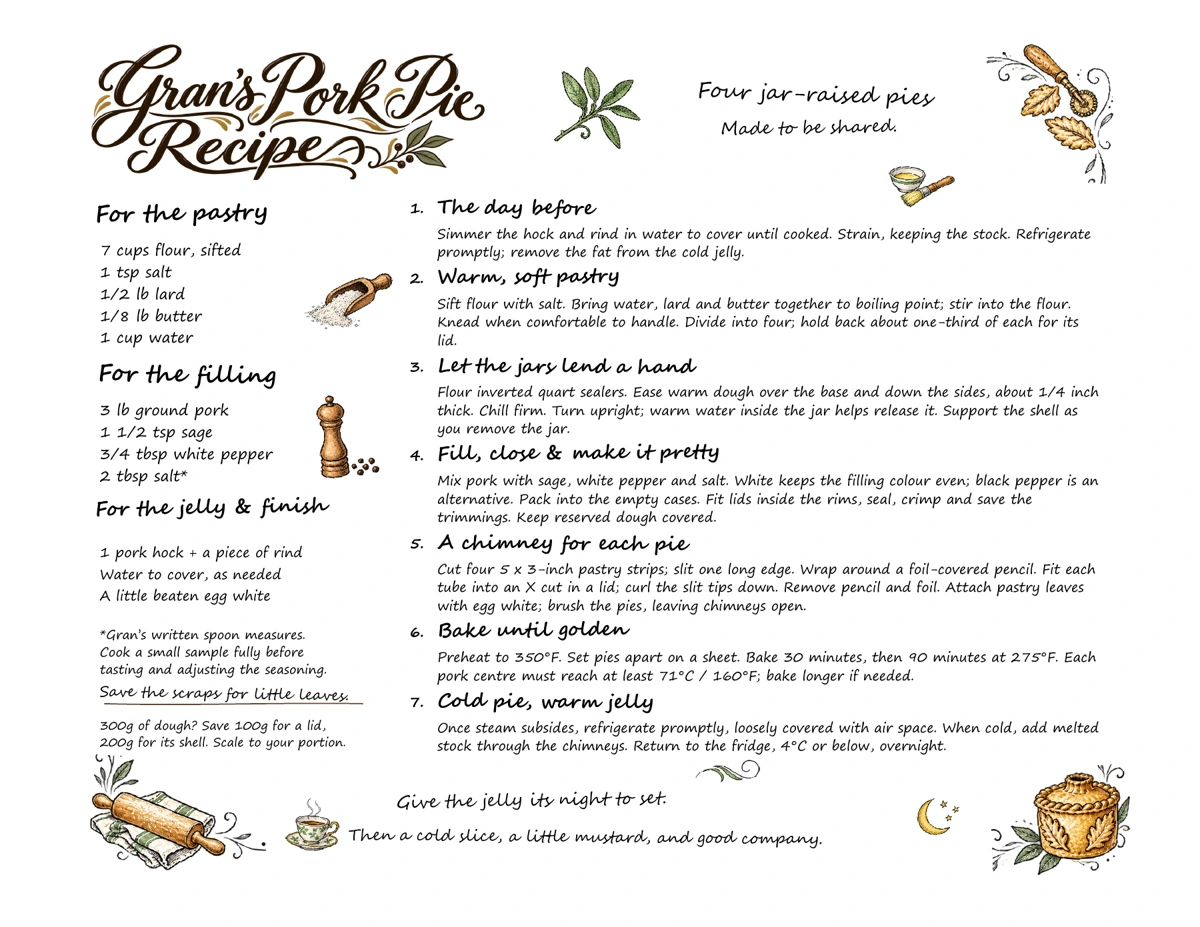
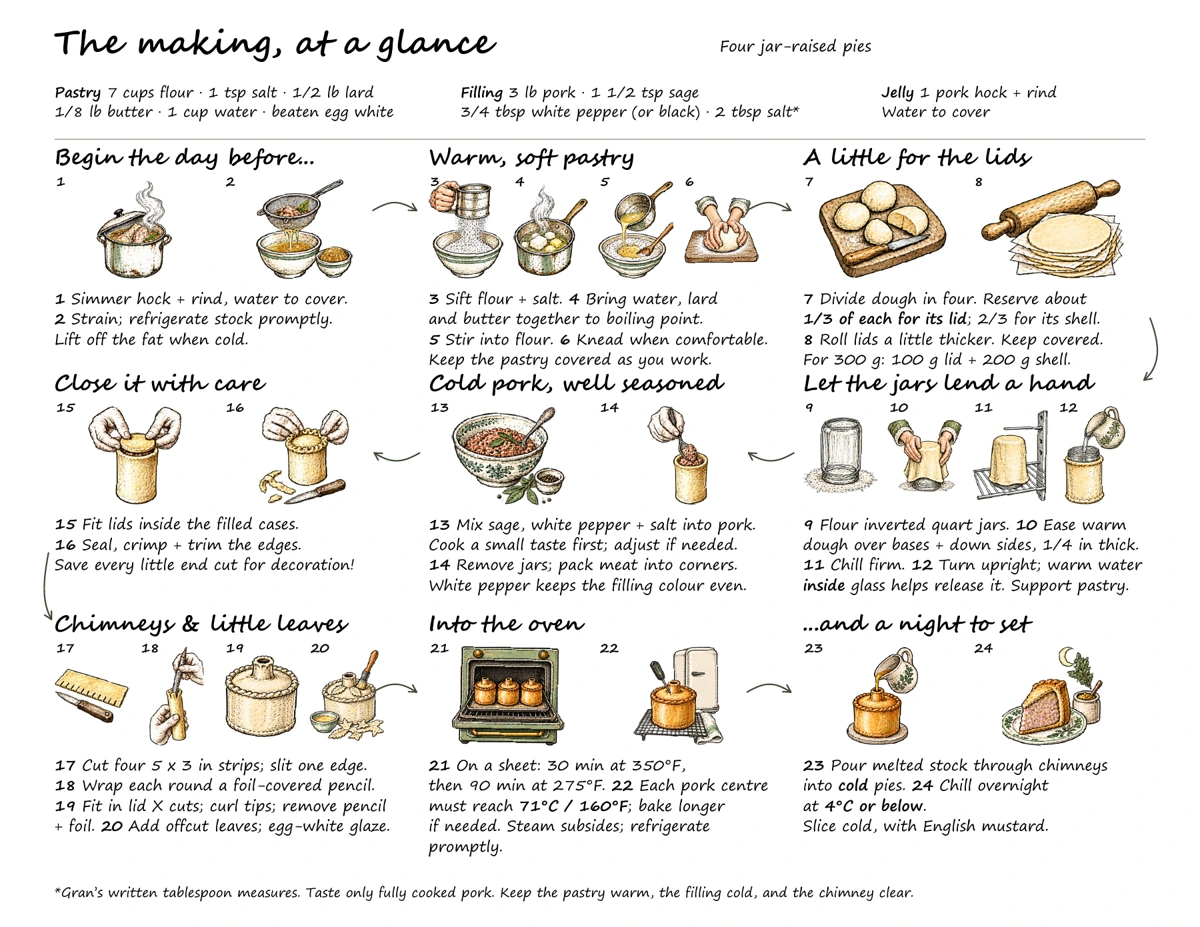
Two illustrated keepsakes: Gran’s recipe on page one, the 24-step visual guide on page two. Save either sheet, or print them back to back.

IN THE MARGINS

THE ORIGINAL & A CAREFUL READING

Original image ↗
Reading notes & uncertainties